Why the portal, API, and SDK share the same engine
Offering more ways in is not enough: what matters is one execution logic behind the portal, the API, and the SDKs.
Subspace
When a product offers several ways to use it, it is easy to assume those are simply separate interfaces side by side.
A portal for business users.
An API for developers.
An SDK for integrations.
From the outside, that can look like three different doors to three different experiences.
But in many cases, the real trouble starts right there.
Because when each interface sits on different logic, costs come back quickly:
- duplication
- divergence
- heavier maintenance
- less consistent results
- more fragile integrations
- harder evolution
In other words, more entry points does not automatically create coherence.
It can multiply fragmentation instead.
The real goal is not “many interfaces”
The real goal is many ways to reach the same logic, without reimplementing it for every context.
In many environments, the same capability ends up in several shapes:
- one version visible in the UI
- one version exposed by an API
- one version tailored to a script
- sometimes another rebuilt in a neighboring system
Once those variants multiply, cost rises.
You must maintain.
You must verify.
You must test several paths.
You must reconcile results.
You must keep everything moving together.
So the problem is not only opening more access.
The problem is keeping a single execution truth behind that access.
A different approach
A stronger architecture flips the mental model.
Instead of thinking:
- a portal with its own logic
- an API with its own logic
- an SDK with its own logic
you think:
- one shared engine
- several ways to reach the same engine
That sounds small.
It deeply changes how the system can evolve.
When the engine is shared:
- logic is less scattered
- behavior stays more consistent
- changes propagate more easily
- integrations get cleaner
- maintenance drops
What that means for Subspace
In Subspace, what matters is not only that there are:
- a portal
- an API
- SDKs
What matters is that they sit on the same execution logic.
So a model does not need to be redefined differently depending on whether it is used:
- from a UI
- from a backend
- from a Python script
- from a TypeScript application
- inside a broader workflow
The access path changes. The engine stays the same.
That structure is what makes Subspace more than a loose bundle of separate tools.
Diagram: one engine, several doors
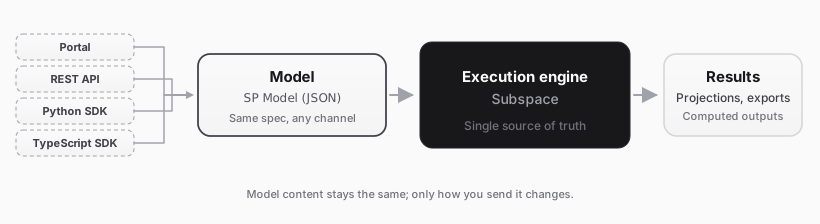
These are not three separate products: it is one engine, surfaced for each context. The hero screenshot (portal spreadsheet view) illustrates the same idea: define the model and run the calculation against the same spec you would send through the API or SDK below.
Minimal example : HTTP API
Same idea as in the portal: an SP Model (scenarios, steps, variables) handed to the engine via POST /simulate (see the developer documentation for full detail).
curl -sS -X POST "https://api.subspacecomputing.com/simulate" \
  -H "Content-Type: application/json" \
  -H "X-API-Key: be_live_..." \
  -d '{"scenarios":1000,"steps":12,"variables":[{"name":"taux","dist":"uniform","params":{"min":0.03,"max":0.07},"per":"scenario"},{"name":"capital","init":1000,"formula":"capital[t-1] * (1 + taux)"}]}'
Minimal example : Python SDK
from subspacecomputing import BSCE

client = BSCE(api_key="be_live_...")
result = client.simulate({
    "scenarios": 1000,
    "steps": 12,
    "variables": [
        {"name": "taux", "dist": "uniform", "params": {"min": 0.03, "max": 0.07}, "per": "scenario"},
        {"name": "capital", "init": 1000.0, "formula": "capital[t-1] * (1 + taux)"},
    ],
})
The spec is the same logical object you can run from the portal or from curl.
Why this matters
When interfaces truly share one engine, several benefits show up.
1. More consistency
Model behavior stays aligned no matter how you call it.
2. Less duplication
You do not rebuild the logic for every context.
3. Less maintenance
When logic changes, you do not patch parallel implementations.
4. Better integration
You can connect Subspace to a product, internal portal, backend, or script without recreating an execution foundation.
5. More flexibility
A team can start one way and expand, for example:
- begin in the portal
- then automate via the API
- then embed via an SDK in a product or workflow
Without swapping engines.
What this changes for an organization
This avoids a common pattern: a system that looks simple at first, then fragments as use cases grow.
One need appears. Then another. Then an integration. Then another UI. Then automation.
If every context needs its own logic, the structure quickly costs more than it seems.
If use cases share one base, growth stays much healthier.
The system becomes:
- more stable
- more reusable
- more evolvable
- easier to sustain over time
The economic angle
This is not only an architecture topic.
It is an economic one.
When many use cases share one logic:
- re-development goes down
- maintenance goes down
- drift between implementations goes down
- integration becomes more cost-effective
- evolving the system costs less
Sharing one engine is not only elegant engineering.
It is also a smarter way to keep analytical models alive.
Conclusion
The value of having a portal, an API, and SDKs is not only the number of options.
It is that those options rest on the same execution engine.
That shared base enables:
- more coherence
- more reuse
- less duplication
- less maintenance
- better integration across contexts
So the key is not only access.
The key is the unity of the logic behind that access.
That is exactly what gives a platform like Subspace its strength.